Comment: 'Look what LLR built without Devo - imagine what we could do with it'

Leicester, Leicestershire and Rutland has built a £26 billion economy and nationally important strengths in manufacturing and life sciences - while remaining outside the mayoral structures through which Government increasingly distributes power and investment.
We worked harder. We fought for investment, rebuilt lost industries, created businesses and formed our own partnerships.
Now imagine what we could achieve with the same tools as others.
That is the case for Devolution. Give us control over the levers of growth and watch what we can do with them.
We already have more than 43,000 enterprises, with around 98% classed as micro or small businesses. We are founders, family businesses, entrepreneurs and independent employers - go-getters and doers.
Manufacturing provides around 61,000 local jobs and represents 11.8% of employment - compared with 7.3% across the UK.
Life sciences is one of our most valuable and least understood strengths.
Local sector mapping identifies 359 health and life sciences businesses. The latest Office for Life Sciences data attributes nearly 6,800 jobs and more than £2.08 billion in annual turnover to companies registered across LLR (OLS 2023/24 company-based data).
Understanding that pharmaceutical manufacturing generates around £530,000 in GVA per worker (more than seven times the UK average of approx £75,000) is key to understanding why this sector matters so much.
It's because, done properly, life sciences growth will change the prospects of our communities for generations.
A host of opportunities
Our capabilities stretch from genetics, precision medicine and clinical research to pharmaceutical development, bioengineering, digital health, medical technology, sport, rehabilitation, healthy living and advanced manufacturing.
Across LLR and its immediate functional economic area, we have three globally-recognised universities, a major research-active NHS trust, an NIHR Biomedical Research Centre, the Defence Medical Rehabilitation Centre, the National Rehabilitation Centre, the UK’s only inland Freeport, and the country’s first Life Sciences Opportunity Zone.
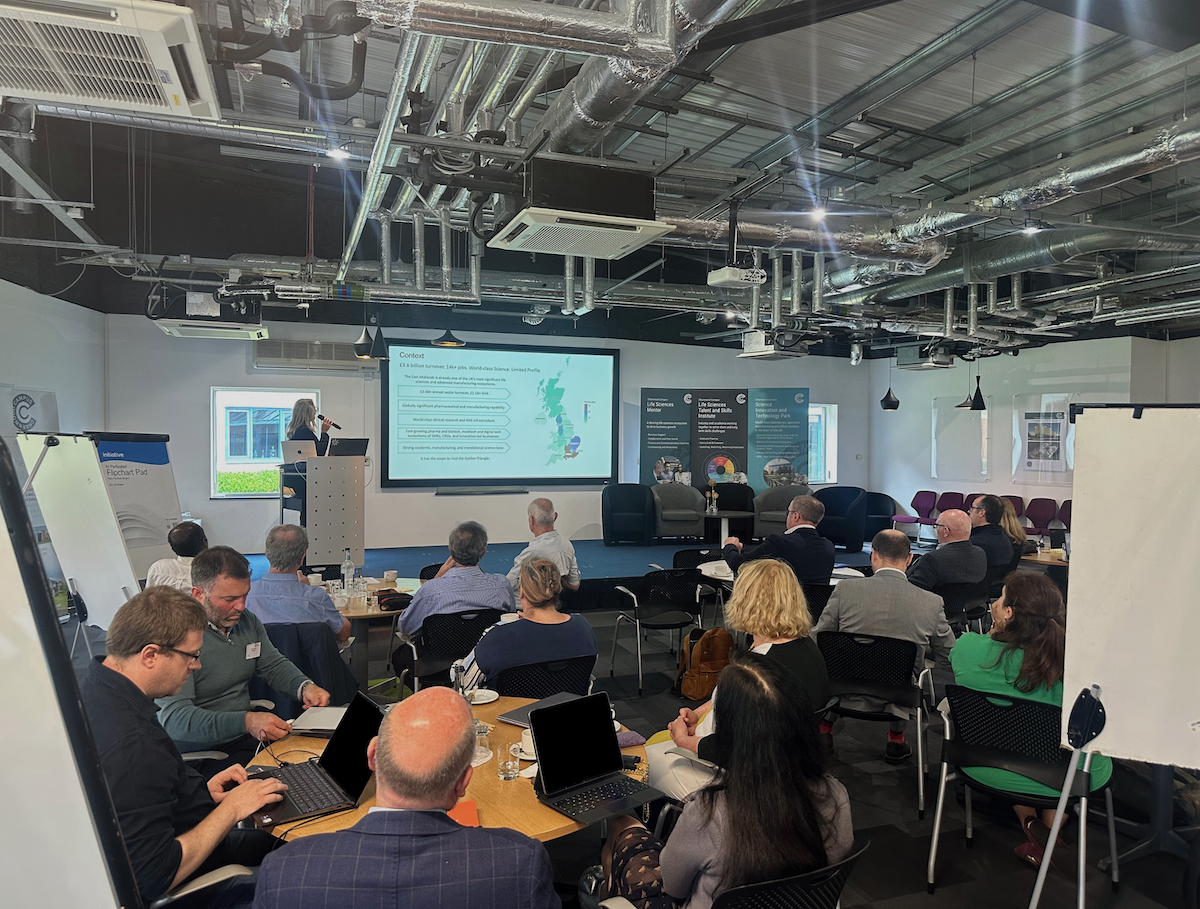
I have seen our resilience first-hand at Charnwood Campus. When AstraZeneca closed its Charnwood research operation in 2011, many assumed Leicestershire had lost its drug-discovery capability. It had not.
Don’t get me wrong - it was brutal. East Midlands biopharmaceutical employment fell by 41% in a single year.
But by 2021/22, employment had recovered to 14% above its pre-closure level. Employment in specialist biopharmaceutical services and supply businesses had more than doubled.
Jobs in life sciences
With the support of the Enterprise Zone designation, more than 800 science jobs have since been created at Charnwood Campus, with a wider supply-chain impact of around 4,000 jobs. We served the nation as a Lighthouse Lab during the pandemic - something I am personally extremely proud of.
Today, Almac Pharmaceutical Services, Kindeva Drug Delivery and Solventum’s UK headquarters provide major anchors across pharmaceutical development, manufacturing, drug-delivery technology and healthcare innovation.
Kindeva’s investment in lower-carbon inhaler technology shows how commercial growth, scientific capability and responsible manufacturing can work together.
The strength goes far beyond one campus: Thermo Fisher Scientific/Fisher Scientific operates in Loughborough. STERIS manufactures in Syston. Spirit Health has built a successful digital-health business in Leicester.
Zydus Pharmaceuticals UK is based in Loughborough, while East Midlands Pharma operates from Rothley and Ilkeston. Near Hinckley, HORIBA MIRA and MIRA Technology Park bring global engineering, testing and advanced-mobility expertise to Leicestershire.
These are businesses operating here now. The wider East Midlands has 511 life sciences companies, 22,413 jobs and £5.8 billion in turnover. Leicester, Leicestershire and Rutland alone account for at least 30% of those jobs and 36% of that turnover.
Research density
The East Midlands also has the fourth-highest density of contract research and manufacturing sites among UK nations and regions - around 69% higher than the West Midlands. Leicester, Leicestershire and Rutland alone accounted for 28% of the East Midlands’ contract research and manufacturing sites. At around 12.5 sites per million residents, our concentration was more than twice that of the West Midlands (OLS 2021/2022).
Our NHS is working directly with global pharmaceutical companies.
Novartis is collaborating with University Hospitals of Leicester to improve metastatic breast cancer services. Sanofi has worked with local partners on COPD, diabetes inequalities, cardiovascular health and post-transplant monitoring.
Across the region, AstraZeneca, MSD, GSK, Amgen and Roche have also worked with NHS organisations on research, treatment pathways and service improvement.
Global pharma can see the value of our clinical expertise, diverse population and ability to turn innovation into patient benefit.
We have national capability, even if we have not always received national recognition. It is time we all caught up.
Shape of Devolution
The world is changing. Artificial intelligence, automation, digital health, advanced manufacturing and data-led drug discovery are rewriting the rules.
Leicester, Leicestershire and Rutland should be investing in that revolution, commercialising it and leading it.
To do that, we need genuine control (over skills, transport, planning, innovation funding, inward investment and business support).
The shape of the Devolution deal matters. So does the pace. Whether it includes an elected Mayor or another model, LLR needs commercially minded, outward-looking leadership that understands entrepreneurs, science, technology and modern manufacturing.
It must be ready to compete for investment and make decisions at the pace of business to help us build companies that scale, export and create wealth here and back advanced and responsible manufacturing, stronger local supply chains and enterprises that generate environmental and social value as they grow.
Profit, purpose and inclusive growth can reinforce one another when businesses are given the right conditions to succeed.
We have already shown what we can achieve without Devolution, but the gap between LLR and mayoral regions is widening because we have talked about devolution for too long . Now we need to agree the right model, secure meaningful powers for LLR and get moving.
The region needs the freedom to act and leaders with the commercial confidence to use it.
The Chancellor recently named Leicester among the places where businesses, universities, investors and local leaders have created successful innovation clusters.
He also promised a permanent transfer of power and resources from Whitehall. We should hold Government to that promise.
Who we are
Devolution Leicestershire is an industry-education-VCSE coalition.
Founded in 2026, its purpose is:
- To accelerate a Devolution deal for Leicester, Leicestershire & Rutland
- To press for fair Government funding for LLR while the Devo deal is done.

Gosia Khrais is Managing Director at Charnwood Campus Science, Innovation and Technology Park. She is a prominent advocate for life sciences in Leicestershire and the East Midlands. Her expertise spans biopharma, medical devices, commercial negotiation, regulation and investment. Gosia works to connect innovation with finance, commercialisation and regional economic opportunity.