What does LLR's LGR decision mean for devolution?
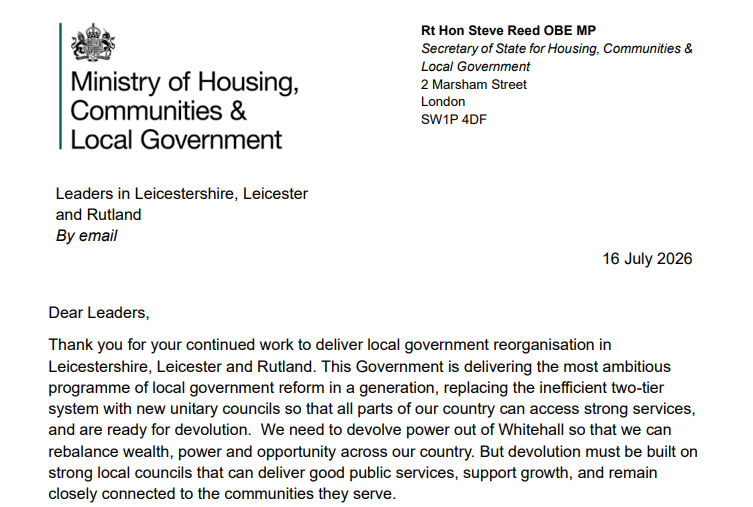

The recent letter from Steve Reed OBE MP - the Secretary of State for Housing, Communities & Local Government - to council leaders in Leicester, Leicestershire & Rutland marks a major milestone in the area’s devolution journey.
It sets out the UK Government’s formal decision on Local Government Reorganisation (LGR), confirming the move towards two new unitary councils across the region and explaining the rationale behind that choice.
Addressed to the leaders of the existing councils, the letter brings together months of consultation, analysis and local debate into a single, clear statement of intent.
The Government’s decision to create two new unitary councils across Leicester, Leicestershire and Rutland marks a defining moment for our area and for the wider devolution agenda.
What the LGR decision actually does
The decision confirms that, from April 2028, existing councils will be replaced by two new unitary authorities covering the whole of Leicester, Leicestershire and Rutland.
One authority will bring together Leicester, Oadby and Wigston, and selected parishes from Blaby, Charnwood and Harborough, with the remainder of Leicestershire and Rutland forming the second authority.
This approach is explicitly designed to fix a long‑standing issue: Leicester’s tightly drawn city boundary, which has not kept pace with where people live, work and access services.
Why this matters for devolution
In the decision letter, the Secretary of State is clear that devolution “must be built on strong local councils” with sensible geographies that reflect real economic areas.
The chosen model is judged to offer the best “long‑term geographic and strategic fit” by aligning councils to the functional urban economy and creating more balanced tax bases and service demands.
This is important because future Strategic Authorities - with elected mayors and wider powers over transport, housing, skills and growth - will only be credible if they are built on robust local structures.
Unlocking homes, jobs and better services
The expansion of Leicester’s boundary is expected to unlock land for thousands of new homes and significant employment space over the next 20 years.
This, in turn, supports economic growth and helps address unmet housing need across the wider area.
The new unitary councils should also be better placed to tailor services to the distinct needs of communities, from social care and public health to transport and regeneration.
A platform for Leicester & Leicestershire’s voice
For Leicester and Leicestershire, this reorganisation is not the end of the story but the platform for the next phase: securing a devolution deal that reflects local priorities.
With clearer boundaries and stronger councils, the area should be better placed to argue for the powers and investment it needs - and to design place‑based solutions that match local identity and ambition.
As discussions about devolution continue, the focus now must be on using this once‑in‑a‑generation change to deliver tangible benefits for residents, communities and businesses across our region.
- There's more about LGR on our local authorities' Future LLR website
Who we are
Devolution Leicestershire is an industry-education-VCSE coalition.
Founded in 2026, its purpose is:
- To accelerate a Devolution deal for Leicester, Leicestershire & Rutland
- To press for fair Government funding for LLR while the Devo deal is done.

Amy Orton is Account Director for 1284 Communications. She is a board member at Menphys. Amy was previously the Local Democracy Reporter for Leicestershire. Her role was funded by the BBC to report on local government in LLR for shared use by a host of media titles.